Let me get one thing straight before you read another word: I'd given up. My cat hated every brush I'd ever bought — she'd hear the drawer open and vanish under the bed. So at some point I just… stopped. I decided she was a cat who didn't like being groomed, and that was that. When a friend mailed me "the only one that'll work, I promise," I left it on the counter for a week out of pure spite.
I'm telling you this because if a brush can win over a cat who hides from brushes — and a person who'd quit trying — it can win over anybody. This is the only product review I've ever felt the need to write down.
First, the body countThe graveyard in my bathroom drawer
If you own a cat that sheds, you have this drawer too. The one full of brushes your cat has personally rejected. Here's what's in mine, and what each one cost me before my cat sentenced it to the junk pile:
- ✕The deshedding tool everybody filmsLooks amazing in the video. On my cat? She tolerated it for ten seconds, then it just glided over the top and grabbed almost nothing.
- ✕The rubber grooming gloveShe actually liked this one — because it barely did anything. A light dusting of surface hair and a lot of static. Felt like petting, worked like petting.
- ✕The slicker brushFine little wires. Pulled a bit of fluff, then dragged across the surface and made her flatten her ears. Good for a quick tidy, useless for the real shedding.
- ✕A fine cat comb + two I can't nameA metal comb, a "self-cleaning" thing, a glove with nubs. A whole museum of stuff she sat through once and never again.
Add it up — that's about $150 of "this'll fix it." Spoiler: it did not fix it.
Every single one followed the same sad pattern. A little fluff the first couple uses, then my cat would have nothing to do with it — and the shedding rolled right on. You're left with one more brush one more rejected brush in the drawer and a cat who trusts you slightly less.
The part that actually got to meThe hairballs. And fur on every single thing I own.
Here's the real reason I cared. It wasn't vanity. It was the relentless, low-grade mess of it.
A hairball on the rug most weeks — always found with a bare foot in the dark. Black leggings I'd given up on entirely. Cat fur spun into the couch, the duvet, somehow the inside of the fridge. And every time she coughed one up I'd think the same guilty thought: that's loose fur I was supposed to get out, and didn't.
So no — I wasn't in the market for another brush. I'd quit. I was just tired and a little resigned. There's a difference, and the pet industry has made a fortune selling to the difference.
The reluctant trialFour minutes. And she didn't run.
I finally picked it up — a flat double-sided comb, nothing fancy, no batteries, no app — caught the cat mid-nap on the couch, and braced for the usual fight where she turns into a swivelling pretzel and leaves. I was ready to prove my friend wrong.
I started combing. And almost immediately it pulled out this thick, dead, fluffy undercoat — not the surface hair the other brushes skim, but the stuff underneath. And she… stayed. Started purring, actually. Four or five minutes later there was a pile on the cushion next to me I'm not exaggerating about. Enough loose fluff to knit a second cat. Off one cat who supposedly "had no fur to give."
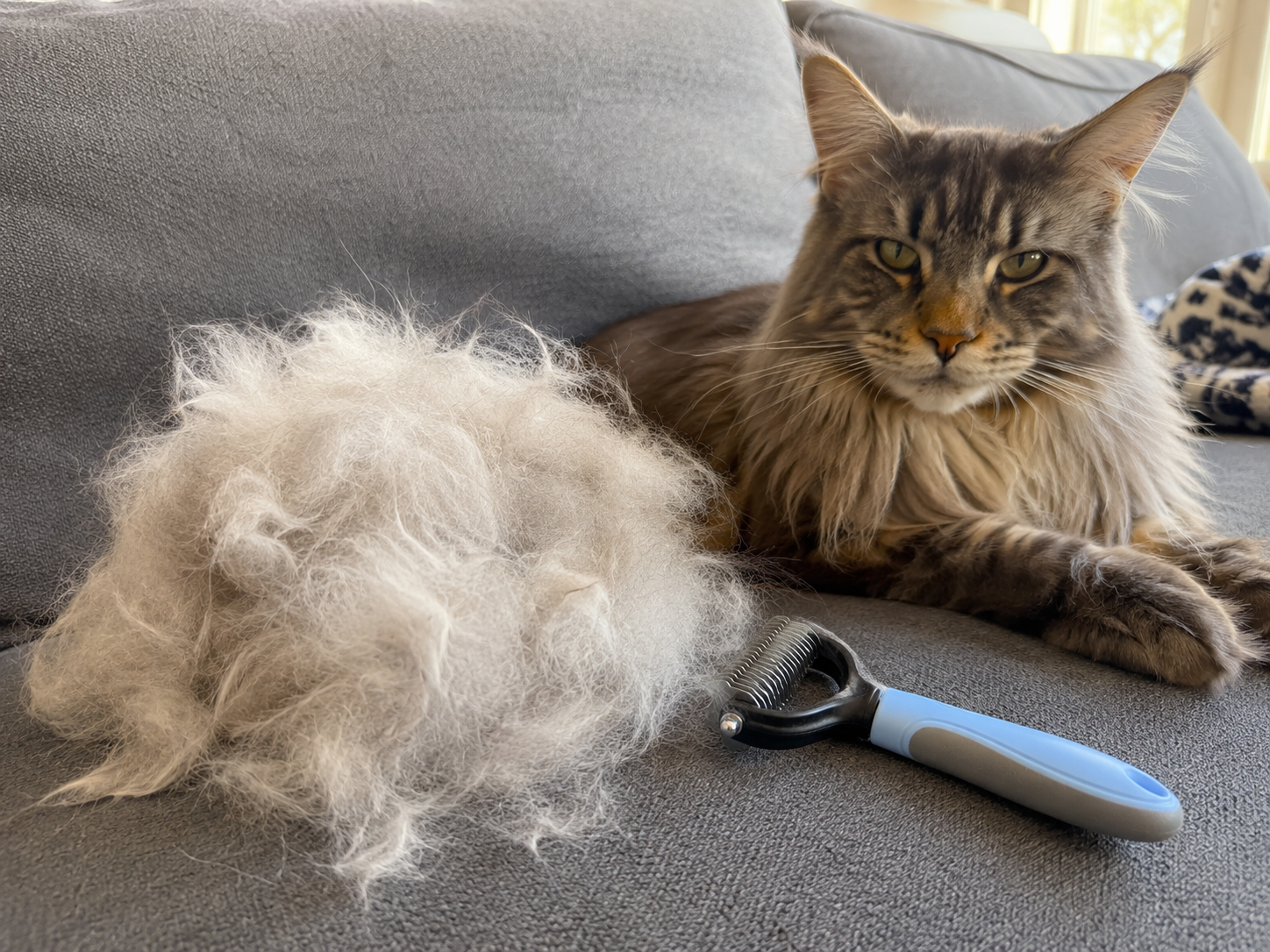
My first thought wasn't "wow, great product." My first thought was: where was all that fur a minute ago, and why did six other brushes never touch it?
Here's the part nobody told meWhy every brush in that drawer was doomed
So I looked it up, because I needed to understand why before I'd believe it wasn't a fluke. And it turns out the answer is stupidly simple — the kind of thing that makes you a little annoyed nobody just said it on the box.
Most long-haired and plush-coated cats have a double coat — Maine Coons, Persians, Ragdolls, British Shorthairs, and plenty of "just a fluffy housecat" mixes too. Two completely different layers doing two different jobs:
Every brush in my drawer was built to comb the topcoat — the long guard hairs on the surface. They glide right across the top and feel productive. But the fur that's actually shedding all over your house comes from the undercoat underneath, and those tools never reach it.
You weren't buying bad brushes. You were buying the right tool for the wrong layer — over and over.
That's the whole con of "reduces shedding" written on a box. Of course it reduces shedding a little — for a few days — by tidying the surface. Then the undercoat keeps right on dying and letting go, and you're back to hairballs and lint rollers. The brush didn't lie, exactly. It just never went where the problem lives.
Keeping myself honestYes, some tools DO reach the undercoat. I won't lie to you.
Here's where I split off from every other "throw out everything you own" review: there are tools that get down into that undercoat. The proper undercoat rakes — the ones with little curved blades tucked behind a rounded guard — those genuinely work. If I told you they didn't, I'd be running the exact same con the brush companies ran on me. So I won't.
Which leaves the one question a pragmatist should actually ask: if a bladed rake already does the hard part, why am I still reaching for a $27 comb instead? Two honest reasons.
Why I keep reaching for this oneIt's a comb, not a rake. No blades, two jobs.
Here's the actual mechanism, and it's almost dumb how straightforward it is. This thing has two different sides on purpose:
Reason one: no blades, period. This matters ten times more with a cat. A rake does its work with little metal blades behind a guard — and a squirming cat plus tiny blades is exactly the combination I never wanted near her skin. This does it with rounded comb teeth instead: nothing sharp, nothing to nick, nothing for a twitchy cat to feel. The tips are rounded so it glides instead of digging. My cat used to bolt when a brush appeared. Now she kneads the couch and stays put.
Reason two: it does both jobs. A good rake pulls the undercoat and then it's done — the coat's clean but left standing up rough, so you still reach for a second comb to finish it. This one has the finish built in. Pull the dead undercoat with the coarse side, lay the topcoat back down smooth with the fine side, one tool, done. I'm not digging through a drawer for the "other" one anymore.
"If a person who gave up brushing her cat is writing 1,200 words about a $27 comb, just try the thing."
See the comb & the guarantee Backed by an unconditional money-back promiseWhere I landedHairballs went from weekly to "huh, can't remember the last one"
I'm not going to tell you the fur vanished from the universe. She's still a cat; she still sheds. But here's the honest before-and-after from someone who'd flat-out quit:
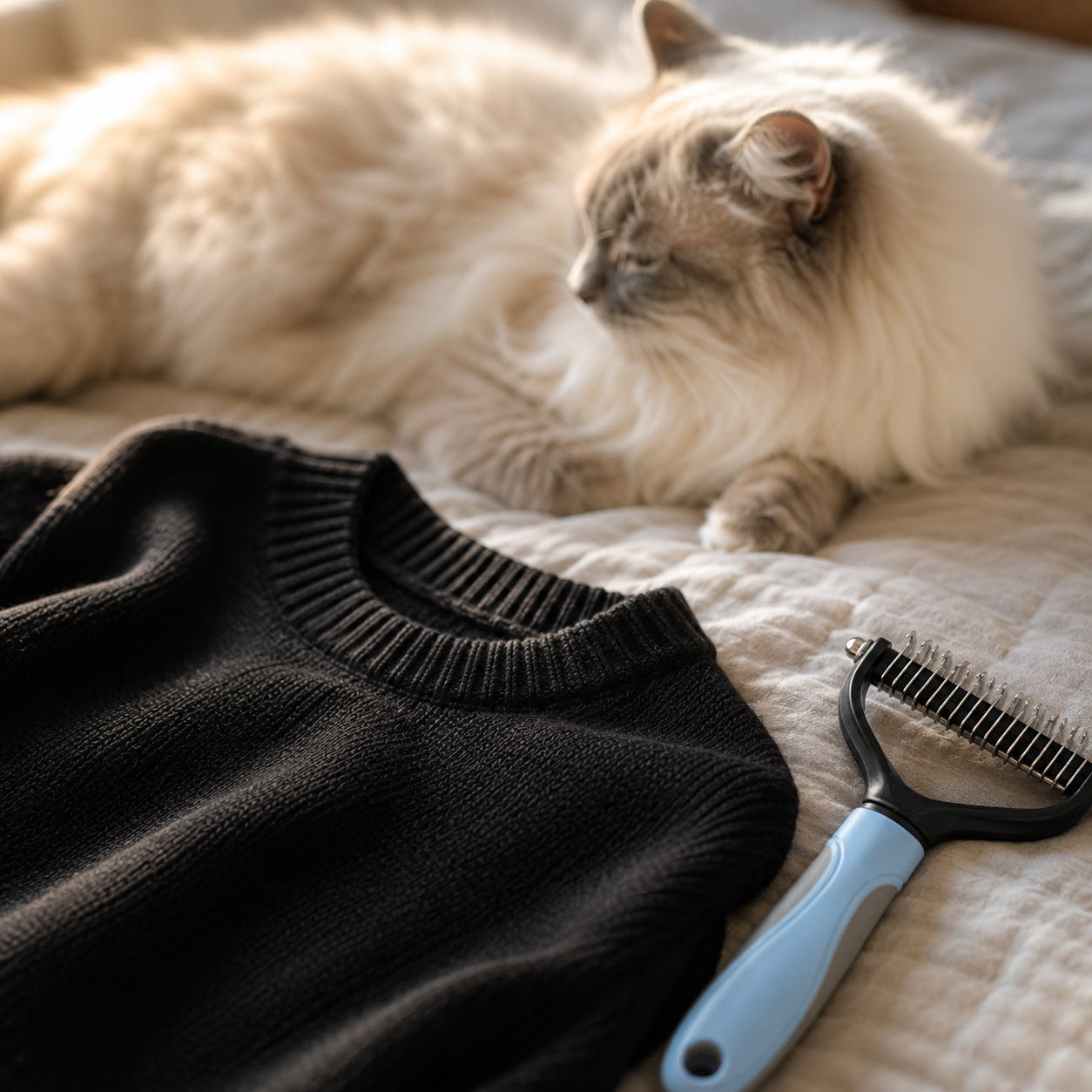
I comb her for about ten minutes, maybe twice a week, on the couch while we watch TV — she comes and finds me for it now. The hairballs basically stopped. I wore a black sweater on purpose last week just to test it and stayed clean. The lint-roller-by-the-door has mostly retired.
And yeah — I texted my friend that she was right. She's not letting me forget it. Worth it.